01
Subgrade on clay
We prep, moisture-condition, and compact the subgrade over the expansive clay so the path holds its line instead of rising and dropping in spots as the soil wets and dries.
Paths that stay flat and walk true, pitched to shed water and finished for grip in the rain, set on a base built for North Texas clay and the slow-draining ground that comes with the lake nearby.
Credibility comes from how it's built, not from promises. Here's the order of operations on every concrete sidewalks & walkways job.
We prep, moisture-condition, and compact the subgrade over the expansive clay so the path holds its line instead of rising and dropping in spots as the soil wets and dries.
A walkway goes down on a 4-inch slab, more than enough for the foot traffic a path carries day to day.
We set the control joints at a spacing that hands the slab chosen seams to travel along as the clay below puffs up and draws back through the seasons.
We set the pitch so rain runs off the path rather than ponding and feeding a lopsided swell in the clay, a problem that arrives faster on the damp lots near the lake.
A broom finish keeps footing sure once the path turns wet.
Most contractors vanish after the deposit. We pick up the phone, show up when we say, and stand behind the work after the truck leaves. The follow-through is the difference.
A foreman we know runs your job and a vetted crew does the work, managed by Lucky's, one company accountable from the first call to the final walkthrough.
COI and lien waivers on file before we break ground. The documentation that lets commercial clients pay and gives homeowners peace of mind.
Prepped subgrade, reinforced and mixed to spec for the job, and proper curing. We build credibility through the process, not promises. On concrete sidewalks & walkways, that starts with subgrade on clay.
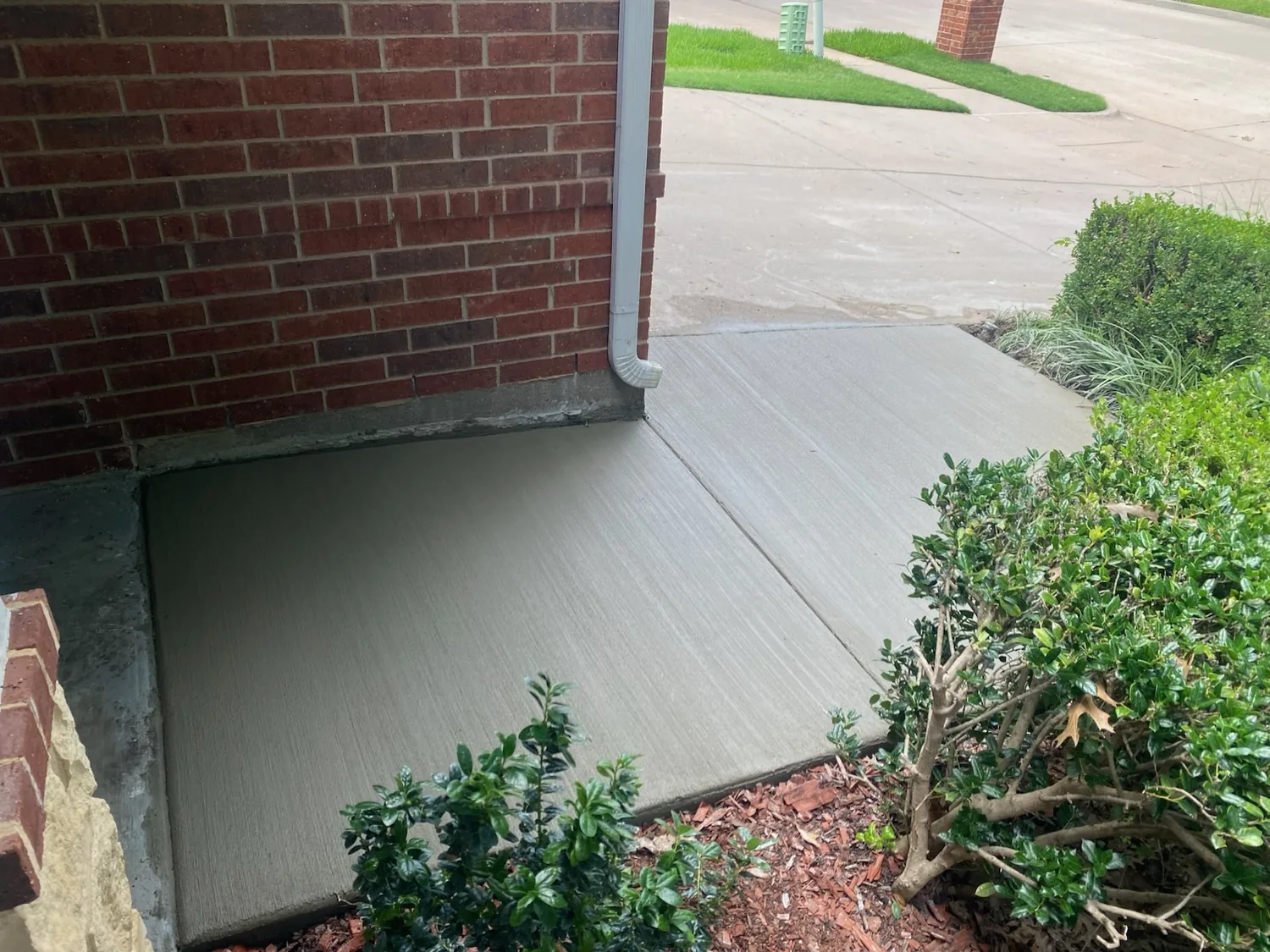
A walkway in North Texas draws its price from width, thickness, and the clay base work, plus the slip-aware finish, the slope, and the drainage the damper lake lots ask for. To put a starting figure on it, walkways tend to begin around $8 to $13 per square foot. We firm the number up once we have paced off the run.
Often, yes. A lone panel that shifting clay or a tree root has heaved can frequently be ground flush or pulled and reset on its own, no need to redo the entire path. We work out what pushed it up before we settle on the fix.
Expansive clay puffing up and tightening down with each wet and dry stretch jacks the panels out of line, and tree roots add to it, both of which move faster on the damper lots near the lake. On the repair we rebuild the base and redo the joint layout so the lift doesn't simply come back.
Yes. We pour ramps and approaches to the slope and surface accessibility requires, topped with a slip-aware texture. Let us know how the ramp gets used and we build it to suit.
We tie the joint spacing to the slab's width and thickness so the movement stays under control, because cutting joints short is exactly where runaway cracking gets its start, and our shrink-swell clay gives no quarter on it.
Hold off using the fresh walk for a few days while the slab sets up. We pass along the specific timeline for your pour ahead of time, with that week's heat figured in.
You'll hear back from a real person, usually the same day. No call center, no runaround, no chasing us down.
Booking up fast this season. Or call (469) 972-5527